
Business Observability: from technical signal to business impact
Discover how Guillaume Baudart turns observability into a strategic lever for driving system performance and reliability.
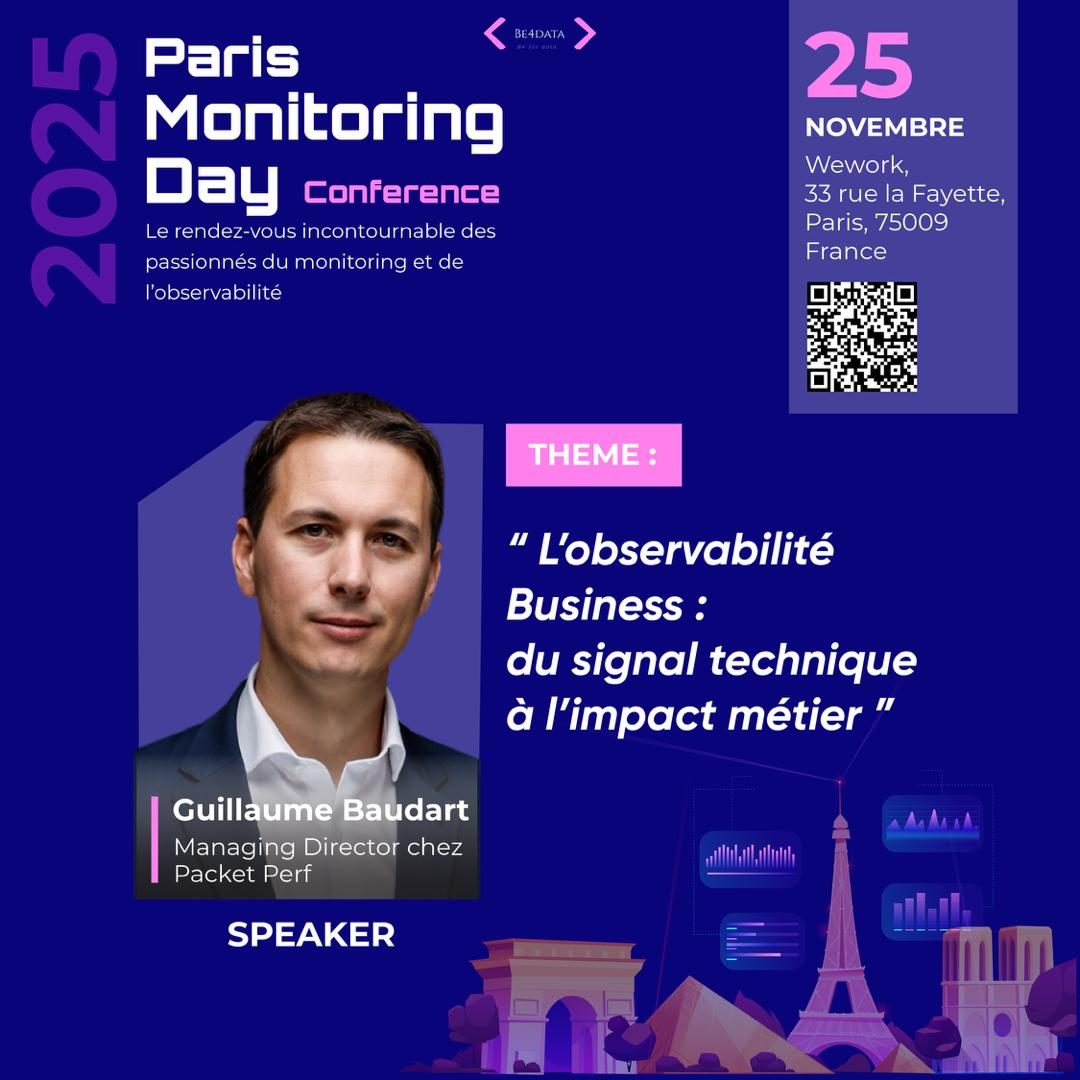
When technical data becomes a strategic lever for the business
In many companies, observability stays confined to the technical sphere. We talk about metrics, logs, traces, dashboards. But all too often, this wealth of information stops at the borders of IT. What if these technical signals could become a genuine source of business decision-making?
That's precisely the challenge Guillaume Baudart will take on at Paris Monitoring Day 2025, with a session dedicated to Business Observability. His goal: to show how to connect system performance to economic performance, so that monitoring becomes not just a detection tool, but a decision-making tool.
From technical monitoring to strategic steering
Traditionally, monitoring aims to detect and resolve incidents as quickly as possible. It focuses on availability, errors, response times or resource saturation. But these indicators, however precise, say nothing about their real impact on the business.
Take a simple example:
An e-commerce application experiences a spike of HTTP 500 errors for 20 minutes. On the technical side, monitoring shows a service degradation. On the business side, this translates into lost revenue — but without correlation between the two, there's no way to measure the actual scale.
Business observability fills this gap. By correlating technical signals with business events, we move from an approach centered on system performance to one centered on value created — or lost.
From raw data to business indicators
Business observability rests on a simple but powerful idea: every piece of technical data has business meaning, provided it's put back in the right context.
To achieve this, Guillaume Baudart proposes a multi-step approach:
- Collect data at every level of the information system
Infrastructure metrics
- Application logs
- Distributed traces
- User experience (RUM, feedback, conversion rates, etc.)
- Correlate these signals with business events
Transactions, sales, customer journeys, wait times, user engagement...
- Give it meaning through hybrid indicators For example:
Average response time on a critical service = direct impact on average basket size.
- Error rate on a microservice = estimate of lost revenue.
- Downtime = cost of the incident per minute.
This process turns technical data into indicators that decision-makers can understand, opening the way to fluid dialogue between IT and the business.
"Observing also means understanding what you impact"
For Guillaume Baudart, business observability isn't just a set of data or a tool: it's a philosophy of decision-making. Its aim is to reconnect IT teams and business teams around a shared goal: the overall performance of the company.
In this light, SREs, DevOps engineers and observability engineers become key players in company strategy, able to inform decisions based on real-time data.
The concrete benefits of business-oriented observability
Putting such an approach in place requires cultural and technical change. But the benefits are significant:
- Better incident prioritization: teams focus their efforts on the problems with real economic impact.
- Reduced financial losses: every minute of downtime is quantifiable and measurable.
- Stronger IT / business alignment: decisions are made on a shared basis of understanding.
- Continuous improvement of user experience: technical signals become levers for optimizing the customer journey.
Toward end-to-end observability
Business observability ultimately rests on an integrated vision: stop splitting the system into silos (infrastructure, application, user, business), and instead link them in a complete value chain.
This approach makes it possible to:
- detect anomalies earlier;
- understand their real origin;
- anticipate impacts before they show up;
- and steer the company's resilience with shared indicators.
Join us at Paris Monitoring Day 2025
Guillaume Baudart's session promises to be one of the highlights of Paris Monitoring Day. With concrete examples, real use cases and a pragmatic vision, he will show how to turn observability into a strategic decision-making tool, in service of performance, reliability and growth.
📅 Paris Monitoring Day – November 25, 2025 🎙️ Talk: "Business Observability: from technical signal to business impact" 🎟️ Register now → Ticketing